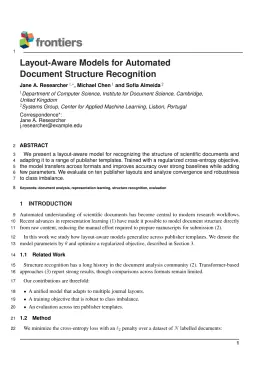
BMC (BioMed Central)

Microbial Cell Factories Template

Write in a clean editor, then format for Microbial Cell Factories in one click — DocuGuru applies the official BMC (BioMed Central) template with numbered references and exports a submission-ready PDF plus the editable LaTeX source. Free to start.

About the Microbial Cell Factories format

Microbial Cell Factories is a peer-reviewed journal published by BMC (BioMed Central), covering Microbial Metabolic Engineering and Bioproduction, Bacterial Genetics and Biotechnology, Biofuel production and bioconversion. Over its lifetime it has published 4,062 papers, which have received 185,834 citations.

PublisherBMC (BioMed Central)
Reference styleNumbered (Vancouver)
Numbered — [1], [2] in the text
1. Smith A, Jones B, Lee C. A representative article title. Microbial Cell Factories. 2023;12(3):45–58.

Formats any DOI in Microbial Cell Factories style. No sign-up.

Publishes research inMicrobial Metabolic Engineering and Bioproduction Bacterial Genetics and Biotechnology Biofuel production and bioconversion Fungal and yeast genetics research Enzyme Catalysis and Immobilization
ISSN1475-2859
Citation impact (2-yr)7.03
h-index166
i10-index2,929
Article processing charge$2,440
Open accessYes — indexed in DOAJ
Top institutions publishing hereChinese Academy of Sciences
Journal websitemicrobialcellfactories.biomedcentral.com
You getA submission-ready PDF and the editable LaTeX source — ready to submit.

Papers published in Microbial Cell Factories per year

236
2014
210
2015
215
2016
233
2017
220
2018
218
2019
219
2020
235
2021
280
2022
262
2023
350
2024
282
2025

Citation impact of Microbial Cell Factories by publication year

14.7K
2014
12.3K
2015
14.4K
2016
13.1K
2017
12.3K
2018
12K
2019
11.8K
2020
8.7K
2021
6.3K
2022
5K
2023
3.8K
2024
1.4K
2025

Citations each year’s papers have accumulated so far — the most recent years are still building up.

Most-cited papers in Microbial Cell Factories

The promising future of microalgae: current status, challenges, and optimization of a sustainable and renewable industry for biofuels, feed, and other products

Muhammad Imran Khan, Jin Hyuk Shin, Jong Deog Kim · 5 Mar 2018

Microalgae have recently attracted considerable interest worldwide, due to their extensive application potential in the renewable energy, biopharmaceutical, and nutraceutical industries. Microalgae are renewable, sustainable, and economical sources of biofuels, bioactive medicinal products, and food ingredients. Several microalgae species have been investigated for their potential as value-added products with remarkable pharmacological and biological qualities. As…

2,050 citations Cite SaveGo to paper →
Biofertilizers function as key player in sustainable agriculture by improving soil fertility, plant tolerance and crop productivity

Deepak Bhardwaj, Mohammad Wahid Ansari, Ranjan Kumar Sahoo et al. · 8 May 2014

Current soil management strategies are mainly dependent on inorganic chemical-based fertilizers, which caused a serious threat to human health and environment. The exploitation of beneficial microbes as a biofertilizer has become paramount importance in agriculture sector for their potential role in food safety and sustainable crop production. The eco-friendly approaches inspire a wide range of…

1,165 citations Cite SaveGo to paper →
Current knowledge and perspectives of Paenibacillus: a review

Elliot Grady, Jacqueline MacDonald, Linda Liu et al. · 1 Dec 2016

Isolated from a wide range of sources, the genus Paenibacillus comprises bacterial species relevant to humans, animals, plants, and the environment. Many Paenibacillus species can promote crop growth directly via biological nitrogen fixation, phosphate solubilization, production of the phytohormone indole-3-acetic acid (IAA), and release of siderophores that enable iron acquisition. They can also offer protection…

Beneficial effects on host energy metabolism of short-chain fatty acids and vitamins produced by commensal and probiotic bacteria

Jean Guy LeBlanc, Florian Chain, Rebeca Martín et al. · 8 May 2017

The aim of this review is to summarize the effect in host energy metabolism of the production of B group vitamins and short chain fatty acids (SCFA) by commensal, food-grade and probiotic bacteria, which are also actors of the mammalian nutrition. The mechanisms of how these microbial end products, produced by these bacterial strains, act…

Microbial lipases and their industrial applications: a comprehensive review

Prem Chandra, Enespa, Ranjan Singh et al. · 26 Aug 2020

Lipases are very versatile enzymes, and produced the attention of the several industrial processes. Lipase can be achieved from several sources, animal, vegetable, and microbiological. The uses of microbial lipase market is estimated to be USD 425.0 Million in 2018 and it is projected to reach USD 590.2 Million by 2023, growing at a CAGR…


Microbial Cell Factories template — frequently asked questions

How do I write a paper in the Microbial Cell Factories format?
In DocuGuru you write your manuscript in a normal editor — no LaTeX setup required — and select the Microbial Cell Factories template. When you export, DocuGuru compiles the paper into the official BMC (BioMed Central) format and hands you a submission-ready PDF along with the editable LaTeX source.
What reference style does Microbial Cell Factories use?
Microbial Cell Factories uses Numbered (Vancouver) references, shown as numbered [1], [2] markers in the text. DocuGuru formats every in-text citation and the reference list in this exact style automatically. A reference appears like this: 1. Smith A, Jones B, Lee C. A representative article title. Microbial Cell Factories. 2023;12(3):45–58.
Do I need to know LaTeX to submit to Microbial Cell Factories?
No. DocuGuru generates the bmcart LaTeX class and compiles the PDF for you in the background, so you get a BMC (BioMed Central)-ready Microbial Cell Factories document without writing any LaTeX. If you do want it, the LaTeX source is included in the export.
Can I import an existing draft into the Microbial Cell Factories template?
Yes. Paste or upload your current manuscript — Word, LaTeX, Markdown, or plain text — and DocuGuru reflows it into the Microbial Cell Factories format with correct headings, figures, tables, and numbered citations.
What is Microbial Cell Factories?
BMC / BioMed Central journal. It is a life sciences and medicine journal, published by BMC (BioMed Central).
Can I export a submission-ready Microbial Cell Factories PDF?
Yes — DocuGuru produces a PDF built with the official Microbial Cell Factories template (the bmcart class) that is ready to submit to BMC (BioMed Central), together with the matching LaTeX source files.
How much does the Microbial Cell Factories template cost?
You can start writing in the Microbial Cell Factories template for free. Exporting the final submission-ready Microbial Cell Factories PDF and LaTeX source is part of DocuGuru's paid plans — see the app for current pricing.
Use the Microbial Cell Factories template