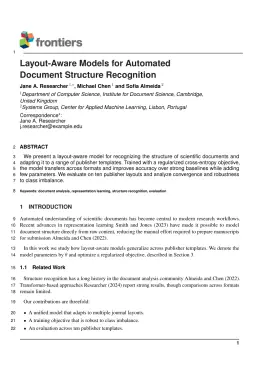
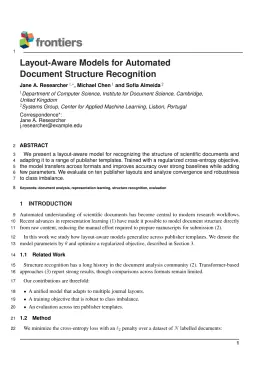
BMC (BioMed Central)

Cancer Cell International Template

Write in a clean editor, then format for Cancer Cell International in one click — DocuGuru applies the official BMC (BioMed Central) template with numbered references and exports a submission-ready PDF plus the editable LaTeX source. Free to start.

About the Cancer Cell International format

Cancer Cell International is a peer-reviewed journal published by BMC (BioMed Central), covering Cancer-related molecular mechanisms research, MicroRNA in disease regulation, Ferroptosis and cancer prognosis. Over its lifetime it has published 4,862 papers, which have received 130,723 citations.

PublisherBMC (BioMed Central)
Reference styleNumbered (Vancouver)
Numbered — [1], [2] in the text
1. Smith A, Jones B, Lee C. A representative article title. Cancer Cell International. 2023;12(3):45–58.

Formats any DOI in Cancer Cell International style. No sign-up.

Publishes research inCancer-related molecular mechanisms research MicroRNA in disease regulation Ferroptosis and cancer prognosis Circular RNAs in diseases Cancer Cells and Metastasis
ISSN1475-2867
Citation impact (2-yr)5.74
h-index117
i10-index3,185
Article processing charge$2,440
Open accessYes — indexed in DOAJ
Top institutions publishing hereNanjing Medical University
Journal websitecancerci.biomedcentral.com
You getA submission-ready PDF and the editable LaTeX source — ready to submit.

Papers published in Cancer Cell International per year

146
2014
123
2015
89
2016
124
2017
219
2018
360
2019
600
2020
708
2021
423
2022
336
2023
438
2024
500
2025

Citation impact of Cancer Cell International by publication year

4.5K
2014
6.4K
2015
3.2K
2016
4.8K
2017
8.2K
2018
14.9K
2019
21.6K
2020
21.4K
2021
11.2K
2022
6.2K
2023
4.6K
2024
1.9K
2025

Citations each year’s papers have accumulated so far — the most recent years are still building up.

Most-cited papers in Cancer Cell International

Acidic extracellular microenvironment and cancer

Yukio Kato, Shigeyuki Ozawa, Chihiro Miyamoto et al. · 1 Jan 2013

Acidic extracellular pH is a major feature of tumor tissue, extracellular acidification being primarily considered to be due to lactate secretion from anaerobic glycolysis. Clinicopathological evidence shows that transporters and pumps contribute to H+ secretion, such as the Na+/H+ exchanger, the H+-lactate co-transporter, monocarboxylate transporters, and the proton pump (H+-ATPase); these may also be associated…

1,294 citations Cite SaveGo to paper →
The role of hypoxia in the tumor microenvironment and development of cancer stem cell: a novel approach to developing treatment

Asieh Emami Nejad, Simin Najafgholian, Alireza Rostami et al. · 20 Jan 2021

Hypoxia is a common feature of solid tumors, and develops because of the rapid growth of the tumor that outstrips the oxygen supply, and impaired blood flow due to the formation of abnormal blood vessels supplying the tumor. It has been reported that tumor hypoxia can: activate angiogenesis, thereby enhancing invasiveness and risk of metastasis;…

Resistance to cancer chemotherapy: failure in drug response from ADME to P-gp

Khalid O. Alfarouk, C C Stock, Sophie Taylor et al. · 14 Jul 2015

Cancer chemotherapy resistance (MDR) is the innate and/or acquired ability of cancer cells to evade the effects of chemotherapeutics and is one of the most pressing major dilemmas in cancer therapy. Chemotherapy resistance can arise due to several host or tumor-related factors. However, most current research is focused on tumor-specific factors and specifically genes that…

MicroRNA (miRNA) in cancer

Kaladhar B. Reddy · 2 Apr 2015

In recent years, there has been a tremendous and growing interest among researchers to investigate the role of mircoRNA (miRNA) in normal cellular as well as in disease processes. miRNAs are a family of small non-coding RNAs which were reported to regulate the expression of various oncogenes or tumor suppressor genes. The expression profiling of…

p53 signaling in cancer progression and therapy

Hany E. Marei, Asmaa Althani, Nahla Afifi et al. · 1 Dec 2021

The p53 protein is a transcription factor known as the "guardian of the genome" because of its critical function in preserving genomic integrity. The TP53 gene is mutated in approximately half of all human malignancies, including those of the breast, colon, lung, liver, prostate, bladder, and skin. When DNA damage occurs, the TP53 gene on…


Cancer Cell International template — frequently asked questions

How do I write a paper in the Cancer Cell International format?
In DocuGuru you write your manuscript in a normal editor — no LaTeX setup required — and select the Cancer Cell International template. When you export, DocuGuru compiles the paper into the official BMC (BioMed Central) format and hands you a submission-ready PDF along with the editable LaTeX source.
What reference style does Cancer Cell International use?
Cancer Cell International uses Numbered (Vancouver) references, shown as numbered [1], [2] markers in the text. DocuGuru formats every in-text citation and the reference list in this exact style automatically. A reference appears like this: 1. Smith A, Jones B, Lee C. A representative article title. Cancer Cell International. 2023;12(3):45–58.
Do I need to know LaTeX to submit to Cancer Cell International?
No. DocuGuru generates the bmcart LaTeX class and compiles the PDF for you in the background, so you get a BMC (BioMed Central)-ready Cancer Cell International document without writing any LaTeX. If you do want it, the LaTeX source is included in the export.
Can I import an existing draft into the Cancer Cell International template?
Yes. Paste or upload your current manuscript — Word, LaTeX, Markdown, or plain text — and DocuGuru reflows it into the Cancer Cell International format with correct headings, figures, tables, and numbered citations.
What is Cancer Cell International?
BMC / BioMed Central journal. It is a life sciences and medicine journal, published by BMC (BioMed Central).
Can I export a submission-ready Cancer Cell International PDF?
Yes — DocuGuru produces a PDF built with the official Cancer Cell International template (the bmcart class) that is ready to submit to BMC (BioMed Central), together with the matching LaTeX source files.
How much does the Cancer Cell International template cost?
You can start writing in the Cancer Cell International template for free. Exporting the final submission-ready Cancer Cell International PDF and LaTeX source is part of DocuGuru's paid plans — see the app for current pricing.
Use the Cancer Cell International template