BMC (BioMed Central)

Algorithms for Molecular Biology Template

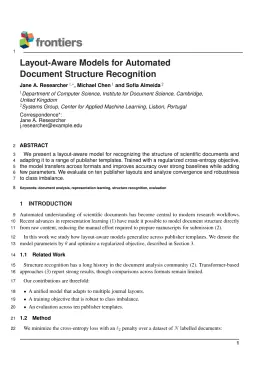
Write in a clean editor, then format for Algorithms for Molecular Biology in one click — DocuGuru applies the official BMC (BioMed Central) template with numbered references and exports a submission-ready PDF plus the editable LaTeX source. Free to start.

About the Algorithms for Molecular Biology format

Algorithms for Molecular Biology is a peer-reviewed journal published by BMC (BioMed Central), covering Genomics and Phylogenetic Studies, Genome Rearrangement Algorithms, Algorithms and Data Compression. Over its lifetime it has published 505 papers, which have received 16,907 citations.

PublisherBMC (BioMed Central)
Reference styleNumbered (Vancouver)
Numbered — [1], [2] in the text
1. Smith A, Jones B, Lee C. A representative article title. Algorithms for Molecular Biology. 2023;12(3):45–58.

Formats any DOI in Algorithms for Molecular Biology style. No sign-up.

Publishes research inGenomics and Phylogenetic Studies Genome Rearrangement Algorithms Algorithms and Data Compression Bioinformatics and Genomic Networks RNA and protein synthesis mechanisms
ISSN1748-7188
Citation impact (2-yr)2.87
h-index51
i10-index272
Article processing charge$1,827
Open accessYes — indexed in DOAJ
Top institutions publishing hereCentre National de la Recherche Scientifique
Journal websitealmob.biomedcentral.com
You getA submission-ready PDF and the editable LaTeX source — ready to submit.

Papers published in Algorithms for Molecular Biology per year

28
2014
31
2015
28
2016
26
2017
17
2018
24
2019
19
2020
26
2021
16
2022
21
2023
24
2024
22
2025

Citation impact of Algorithms for Molecular Biology by publication year

805
2014
689
2015
707
2016
536
2017
249
2018
296
2019
118
2020
200
2021
220
2022
109
2023
126
2024
35
2025

Citations each year’s papers have accumulated so far — the most recent years are still building up.

Most-cited papers in Algorithms for Molecular Biology

ViennaRNA Package 2.0

Ronny Lorenz, Stephan H Bernhart, Christian Höner zu Siederdissen et al. · 24 Nov 2011

BACKGROUND: Secondary structure forms an important intermediate level of description of nucleic acids that encapsulates the dominating part of the folding energy, is often well conserved in evolution, and is routinely used as a basis to explain experimental findings. Based on carefully measured thermodynamic parameters, exact dynamic programming algorithms can be used to compute ground…

5,447 citations Cite SaveGo to paper →
Jane: a new tool for the cophylogeny reconstruction problem

Chris Conow, Daniel C. Fielder, Yaniv Ovadia et al. · 3 Feb 2010

BACKGROUND: This paper describes the theory and implementation of a new software tool, called Jane, for the study of historical associations. This problem arises in parasitology (associations of hosts and parasites), molecular systematics (associations of orderings and genes), and biogeography (associations of regions and orderings). The underlying problem is that of reconciling pairs of trees…

Space-efficient and exact de Bruijn graph representation based on a Bloom filter

Rayan Chikhi, Guillaume Rizk · 1 Jan 2013

BACKGROUND: The de Bruijn graph data structure is widely used in next-generation sequencing (NGS). Many programs, e.g. de novo assemblers, rely on in-memory representation of this graph. However, current techniques for representing the de Bruijn graph of a human genome require a large amount of memory (≥30 GB). RESULTS: We propose a new encoding of…

Partition function and base pairing probabilities of RNA heterodimers

Stephan H Bernhart, Hakim Tafer, Ulrike Mückstein et al. · 1 Jan 2006

BACKGROUND: RNA has been recognized as a key player in cellular regulation in recent years. In many cases, non-coding RNAs exert their function by binding to other nucleic acids, as in the case of microRNAs and snoRNAs. The specificity of these interactions derives from the stability of inter-molecular base pairing. The accurate computational treatment of…

Identification of alternative topological domains in chromatin

Darya Filippova, Rob Patro, Geet Duggal et al. · 1 Jan 2014

Chromosome conformation capture experiments have led to the discovery of dense, contiguous, megabase-sized topological domains that are similar across cell types and conserved across species. These domains are strongly correlated with a number of chromatin markers and have since been included in a number of analyses. However, functionally-relevant domains may exist at multiple length scales.…


Algorithms for Molecular Biology template — frequently asked questions

How do I write a paper in the Algorithms for Molecular Biology format?
In DocuGuru you write your manuscript in a normal editor — no LaTeX setup required — and select the Algorithms for Molecular Biology template. When you export, DocuGuru compiles the paper into the official BMC (BioMed Central) format and hands you a submission-ready PDF along with the editable LaTeX source.
What reference style does Algorithms for Molecular Biology use?
Algorithms for Molecular Biology uses Numbered (Vancouver) references, shown as numbered [1], [2] markers in the text. DocuGuru formats every in-text citation and the reference list in this exact style automatically. A reference appears like this: 1. Smith A, Jones B, Lee C. A representative article title. Algorithms for Molecular Biology. 2023;12(3):45–58.
Do I need to know LaTeX to submit to Algorithms for Molecular Biology?
No. DocuGuru generates the bmcart LaTeX class and compiles the PDF for you in the background, so you get a BMC (BioMed Central)-ready Algorithms for Molecular Biology document without writing any LaTeX. If you do want it, the LaTeX source is included in the export.
Can I import an existing draft into the Algorithms for Molecular Biology template?
Yes. Paste or upload your current manuscript — Word, LaTeX, Markdown, or plain text — and DocuGuru reflows it into the Algorithms for Molecular Biology format with correct headings, figures, tables, and numbered citations.
What is Algorithms for Molecular Biology?
BMC / BioMed Central journal. It is a life sciences and medicine journal, published by BMC (BioMed Central).
Can I export a submission-ready Algorithms for Molecular Biology PDF?
Yes — DocuGuru produces a PDF built with the official Algorithms for Molecular Biology template (the bmcart class) that is ready to submit to BMC (BioMed Central), together with the matching LaTeX source files.
How much does the Algorithms for Molecular Biology template cost?
You can start writing in the Algorithms for Molecular Biology template for free. Exporting the final submission-ready Algorithms for Molecular Biology PDF and LaTeX source is part of DocuGuru's paid plans — see the app for current pricing.
Use the Algorithms for Molecular Biology template