ASME

Journal of Offshore Mechanics and Arctic Engineering Template

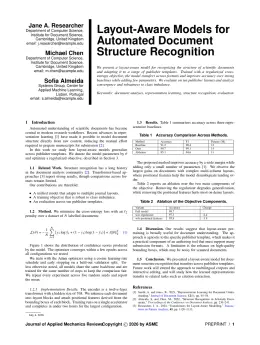
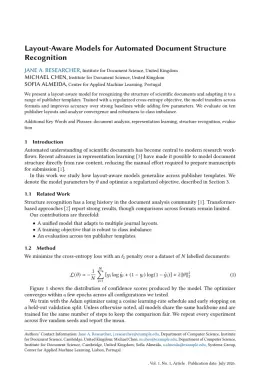
Write in a clean editor, then format for Journal of Offshore Mechanics and Arctic Engineering in one click — DocuGuru applies the official ASME template with numbered references and exports a submission-ready PDF plus the editable LaTeX source. Free to start.

About the Journal of Offshore Mechanics and Arctic Engineering format

Journal of Offshore Mechanics and Arctic Engineering is a peer-reviewed journal published by ASME, covering Wave and Wind Energy Systems, Fluid Dynamics and Vibration Analysis, Fluid Dynamics Simulations and Interactions. Over its lifetime it has published 2,312 papers, which have received 31,764 citations.

PublisherASME
Reference styleNumbered (ASME)
Numbered — [1], [2] in the text
[1] Smith, A., Jones, B., and Lee, C., 2023, "A Representative Article Title," Journal of Offshore Mechanics and Arctic Engineering, 12(3), pp. 45–58.

Formats any DOI in Journal of Offshore Mechanics and Arctic Engineering style. No sign-up.

Publishes research inWave and Wind Energy Systems Fluid Dynamics and Vibration Analysis Fluid Dynamics Simulations and Interactions Structural Integrity and Reliability Analysis Coastal and Marine Dynamics
ISSN0892-7219
Citation impact (2-yr)1.68
h-index67
i10-index913
Top institutions publishing hereNorwegian University of Science and Technology
Journal websiteoffshoremechanics.asmedigitalcollection.asme.org
You getA submission-ready PDF and the editable LaTeX source — ready to submit.

Papers published in Journal of Offshore Mechanics and Arctic Engineering per year

67
2014
71
2015
75
2016
84
2017
117
2018
95
2019
101
2020
80
2021
75
2022
80
2023
80
2024
95
2025

Citation impact of Journal of Offshore Mechanics and Arctic Engineering by publication year

1.7K
2014
1.2K
2015
855
2016
958
2017
1.3K
2018
1.1K
2019
987
2020
651
2021
532
2022
342
2023
253
2024
105
2025

Citations each year’s papers have accumulated so far — the most recent years are still building up.

Most-cited papers in Journal of Offshore Mechanics and Arctic Engineering

VIVACE (Vortex Induced Vibration Aquatic Clean Energy): A New Concept in Generation of Clean and Renewable Energy From Fluid Flow

Michael M. Bernitsas, Kamaldev Raghavan, Y. Ben-Simon et al. · 16 Sep 2008

Any device aiming to harness the abundant clean and renewable energy from ocean and other water resources must have high energy density, be unobtrusive, have low maintenance, be robust, meet life cycle cost targets, and have a 10–20year life. The vortex induced vibration aquatic clean energy (VIVACE) converter—invented by Bernitsas and Raghavan, patent pending through…

Constrained Optimal Control of a Heaving Buoy Wave-Energy Converter

Jørgen Hals Todalshaug, Johannes Falnes, Torgeir Moan · 3 Nov 2010

The question of optimal operation of wave-energy converters has been a key issue since modern research on the topic emerged in the early 1970s, and criteria for maximum wave-energy absorption soon emerged from frequency domain analysis. However, constraints on motions and forces give the need for time-domain modeling, where numerical optimization must be used to…

An Investigation Into the Hydrodynamic Efficiency of an Oscillating Water Column

Michael Morris-Thomas, R. Irvin, Krish Thiagarajan · 19 Jul 2006

An oscillating water column device enables the conversion of wave energy into electrical energy via wave interaction with a semi-submerged chamber coupled with a turbine for power take off. This present work concentrates on the wave interaction with the semi-submerged chamber, whereby a shore based oscillating water column (OWC) is studied experimentally to examine energy…

A Comparison of Selected Strategies for Adaptive Control of Wave Energy Converters

Jørgen Hals Todalshaug, Johannes Falnes, Torgeir Moan · 29 Mar 2011

Wave-energy converters of the point-absorbing type (i.e., having small extension compared with the wavelength) are promising for achieving cost reductions and design improvements because of a high power-to-volume ratio and better possibilities for mass production of components and devices as compared with larger converter units. However, their frequency response tends to be narrow banded, which…

Hydrodynamic Impact Analysis of a Cylinder

R Cointe, J L Armand · 1 Aug 1987

The problem of the vertical entry of a rigid horizontal cylinder into an incompressible inviscid fluid initially at rest is addressed. The contributions of previous researchers are presented and discussed in the light of various assumptions introduced and the validity of the results obtained. Based on this review, realistic simplifying assumptions are introduced and the…

Journal of Offshore Mechanics and Arctic Engineering template — frequently asked questions

How do I write a paper in the Journal of Offshore Mechanics and Arctic Engineering format?
In DocuGuru you write your manuscript in a normal editor — no LaTeX setup required — and select the Journal of Offshore Mechanics and Arctic Engineering template. When you export, DocuGuru compiles the paper into the official ASME format and hands you a submission-ready PDF along with the editable LaTeX source.
What reference style does Journal of Offshore Mechanics and Arctic Engineering use?
Journal of Offshore Mechanics and Arctic Engineering uses Numbered (ASME) references, shown as numbered [1], [2] markers in the text. DocuGuru formats every in-text citation and the reference list in this exact style automatically. A reference appears like this: [1] Smith, A., Jones, B., and Lee, C., 2023, "A Representative Article Title," Journal of Offshore Mechanics and Arctic Engineering, 12(3), pp. 45–58.
Do I need to know LaTeX to submit to Journal of Offshore Mechanics and Arctic Engineering?
No. DocuGuru generates the asmejour LaTeX class and compiles the PDF for you in the background, so you get a ASME-ready Journal of Offshore Mechanics and Arctic Engineering document without writing any LaTeX. If you do want it, the LaTeX source is included in the export.
Can I import an existing draft into the Journal of Offshore Mechanics and Arctic Engineering template?
Yes. Paste or upload your current manuscript — Word, LaTeX, Markdown, or plain text — and DocuGuru reflows it into the Journal of Offshore Mechanics and Arctic Engineering format with correct headings, figures, tables, and numbered citations.
What is Journal of Offshore Mechanics and Arctic Engineering?
ASME journal. It is a engineering and computer science journal, published by ASME.
Can I export a submission-ready Journal of Offshore Mechanics and Arctic Engineering PDF?
Yes — DocuGuru produces a PDF built with the official Journal of Offshore Mechanics and Arctic Engineering template (the asmejour class) that is ready to submit to ASME, together with the matching LaTeX source files.
How much does the Journal of Offshore Mechanics and Arctic Engineering template cost?
You can start writing in the Journal of Offshore Mechanics and Arctic Engineering template for free. Exporting the final submission-ready Journal of Offshore Mechanics and Arctic Engineering PDF and LaTeX source is part of DocuGuru's paid plans — see the app for current pricing.
Use the Journal of Offshore Mechanics and Arctic Engineering template