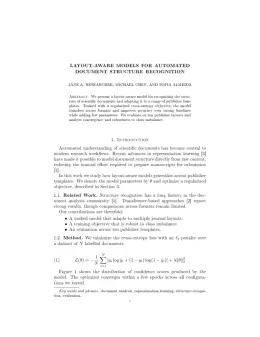
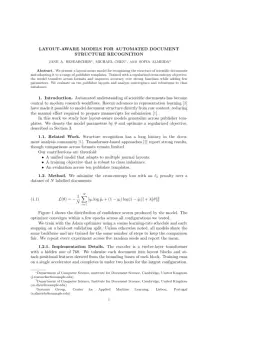
About the Journal of Algebraic Geometry format
Journal of Algebraic Geometry is a peer-reviewed journal published by American Mathematical Society, covering Algebraic Geometry and Number Theory, Advanced Algebra and Geometry, Algebraic structures and combinatorial models. Over its lifetime it has published 677 papers, which have received 14,229 citations.
| Publisher | American Mathematical Society |
|---|
| Reference style | Numbered (AMS) Numbered — [1], [2] in the text
[1] A. Smith, B. Jones, and C. Lee, A representative article title, Journal of Algebraic Geometry 12 (2023), 45–58.
Formats any DOI in Journal of Algebraic Geometry style. No sign-up.
|
|---|
| Publishes research in | Algebraic Geometry and Number Theory Advanced Algebra and Geometry Algebraic structures and combinatorial models Homotopy and Cohomology in Algebraic Topology Geometry and complex manifolds |
|---|
| ISSN | 1056-3911 |
|---|
| Citation impact (2-yr) | 1.93 |
|---|
| h-index | 58 |
|---|
| i10-index | 326 |
|---|
| Top institutions publishing here | Centre National de la Recherche Scientifique |
|---|
| Journal website | www.ams.org |
|---|
| You get | A submission-ready PDF and the editable LaTeX source — ready to submit. |
|---|
Papers published in Journal of Algebraic Geometry per year
Citation impact of Journal of Algebraic Geometry by publication year
Citations each year’s papers have accumulated so far — the most recent years are still building up.
Most-cited papers in Journal of Algebraic Geometry
The pseudo-effective cone of a compact Kähler manifold and varieties of negative Kodaira dimension
Sébastien Boucksom, Jean-Pierre Demailly, Mihai Păun et al. · 31 May 2012
We prove that a holomorphic line bundle on a projective manifold is pseudo-effective if and only if its degree on any member of a covering family of curves is non-negative. This is a consequence of a duality statement between the cone of pseudo-effective divisors and the cone of “movable curves”, which is obtained from a…
F-regular and F-pure rings vs. log terminal and log canonical singularities
Nobuo Hara, Kei-ichi Watanabe · 17 Dec 2001
We investigate the relationship of F-regular (resp. F-pure) rings and log terminal (resp. log canonical) singularities. Also, we extend the notions of F-regularity and F-purity to “F-singularities of pairs." The notions of F-regular and F-pure rings in characteristic <inline-formula content-type="math/mathml"> <mml:math xmlns:mml="http://www.w3.org/1998/Math/MathML" alttext="p greater-than 0"> <mml:semantics> <mml:mrow> <mml:mi>p</mml:mi> <mml:mo>></mml:mo> <mml:mn>0</mml:mn> </mml:mrow> <mml:annotation encoding="application/x-tex">p > 0</mml:annotation>…
Comparing powers and symbolic powers of ideals
Cristiano Bocci, Brian Harbourne · 17 Aug 2009
We develop tools to study the problem of containment of symbolic powers <inline-formula content-type="math/mathml"> <mml:math xmlns:mml="http://www.w3.org/1998/Math/MathML" alttext="upper I Superscript left-parenthesis m right-parenthesis"> <mml:semantics> <mml:msup> <mml:mi>I</mml:mi> <mml:mrow class="MJX-TeXAtom-ORD"> <mml:mo stretchy="false">(</mml:mo> <mml:mi>m</mml:mi> <mml:mo stretchy="false">)</mml:mo> </mml:mrow> </mml:msup> <mml:annotation encoding="application/x-tex">I^{(m)}</mml:annotation> </mml:semantics> </mml:math> </inline-formula> in powers <inline-formula content-type="math/mathml"> <mml:math xmlns:mml="http://www.w3.org/1998/Math/MathML" alttext="upper I Superscript r"> <mml:semantics> <mml:msup> <mml:mi>I</mml:mi> <mml:mi>r</mml:mi> </mml:msup> <mml:annotation…
Moduli of complexes on a proper morphism
Max Lieblich · 7 Sep 2005
Given a proper morphism <inline-formula content-type="math/mathml"> <mml:math xmlns:mml="http://www.w3.org/1998/Math/MathML" alttext="upper X right-arrow upper S"> <mml:semantics> <mml:mrow> <mml:mi>X</mml:mi> <mml:mo stretchy="false"> → </mml:mo> <mml:mi>S</mml:mi> </mml:mrow> <mml:annotation encoding="application/x-tex">X\to S</mml:annotation> </mml:semantics> </mml:math> </inline-formula> , we show that a large class of objects in the derived category of <inline-formula content-type="math/mathml"> <mml:math xmlns:mml="http://www.w3.org/1998/Math/MathML" alttext="upper X"> <mml:semantics> <mml:mi>X</mml:mi> <mml:annotation encoding="application/x-tex">X</mml:annotation> </mml:semantics> </mml:math> </inline-formula>…
A new six-dimensional irreducible symplectic variety
Kieran G. O’Grady · 14 Jan 2003
We construct a six-dimensional irreducible symplectic variety with <inline-formula content-type="math/mathml"> <mml:math xmlns:mml="http://www.w3.org/1998/Math/MathML" alttext="b 2 equals 8"> <mml:semantics> <mml:mrow> <mml:msub> <mml:mi>b</mml:mi> <mml:mn>2</mml:mn> </mml:msub> <mml:mo>=</mml:mo> <mml:mn>8</mml:mn> </mml:mrow> <mml:annotation encoding="application/x-tex">b_2=8</mml:annotation> </mml:semantics> </mml:math> </inline-formula> . Since the known examples of irreducible symplectic varieties have <inline-formula content-type="math/mathml"> <mml:math xmlns:mml="http://www.w3.org/1998/Math/MathML" alttext="b 2 equals 7"> <mml:semantics> <mml:mrow> <mml:msub> <mml:mi>b</mml:mi> <mml:mn>2</mml:mn> </mml:msub> <mml:mo>=</mml:mo>…