AIP Publishing

Nanotechnology and Precision Engineering Template

Write in a clean editor, then format for Nanotechnology and Precision Engineering in one click — DocuGuru applies the official AIP Publishing template with numbered references and exports a submission-ready PDF plus the editable LaTeX source. Free to start.

About the Nanotechnology and Precision Engineering format

Nanotechnology and Precision Engineering is a peer-reviewed journal published by AIP Publishing, covering Advanced Surface Polishing Techniques, Advanced MEMS and NEMS Technologies, Advanced Measurement and Metrology Techniques.

PublisherAIP Publishing
Reference styleNumbered (AIP)
Numbered — [1], [2] in the text
[1] A. Smith, B. Jones, and C. Lee, Nanotechnology and Precision Engineering 12, 45 (2023).

Formats any DOI in Nanotechnology and Precision Engineering style. No sign-up.

Publishes research inAdvanced Surface Polishing Techniques Advanced MEMS and NEMS Technologies Advanced Measurement and Metrology Techniques Advanced machining processes and optimization Force Microscopy Techniques and Applications
ISSN1672-6030
Citation impact (2-yr)2.71
h-index30
i10-index78
Total citations3,474
Open accessYes
Top institutions publishing hereTianjin University
Journal websiteaip.scitation.org
You getA submission-ready PDF and the editable LaTeX source — ready to submit.

Papers published in Nanotechnology and Precision Engineering per year

65
2012
1
2013
2
2014
1
2016
13
2018
31
2019
23
2020
25
2021
23
2022
42
2023
46
2024
46
2025

Citation impact of Nanotechnology and Precision Engineering by publication year

62
2012
0
2013
1
2014
0
2016
233
2018
575
2019
617
2020
562
2021
317
2022
296
2023
237
2024
76
2025

Citations each year’s papers have accumulated so far — the most recent years are still building up.

Most-cited papers in Nanotechnology and Precision Engineering

Theoretical fundamentals of short pulse laser–metal interaction: A review

Xinxin Li, Yingchun Guan · 23 Aug 2020

Short and ultrashort pulse lasers offer excellent advantages in laser precision machining mainly because of their high pulse energy and low ablation threshold. The complex process of laser interaction with metals limits the in-depth investigation into laser ablation. Numerical simulation is important in the study of fundamental mechanisms. This review explores the start-of-the-art methods for…

PEDOT:PSS: From conductive polymers to sensors

Xiaoshuang Zhang, Wentuo Yang, Hainan Zhang et al. · 22 Nov 2021

PEDOT:PSS conductive polymers have received tremendous attention over the last two decades owing to their high conductivity, ease of processing, and biocompatibility. As a flexible versatile material, PEDOT:PSS can be developed into various forms and has had a significant impact on emerging sensing applications. This review covers the development of PEDOT:PSS from material to physical…

Advances in graphene reinforced metal matrix nanocomposites: Mechanisms, processing, modelling, properties and applications

Wenge Chen, Tao Yang, Longlong Dong et al. · 1 Dec 2020

Graphene has been extensively explored to enhance functional and mechanical properties of metal matrix nanocomposites for wide-range applications due to their superior mechanical, electrical and thermal properties. This article discusses recent advances of key mechanisms, synthesis, manufacture, modelling and applications of graphene metal matrix nanocomposites. The main strengthening mechanisms include load transfer, Orowan cycle, thermal…

Sweat detection theory and fluid driven methods: A review

Haixia Yu, Jintao Sun · 27 Aug 2020

In recent years, analyses of sweat have become more popular since it doesn’t require invasive sampling procedures. Although blood still remains the golden standards in clinical, analyses of other common body fluids, such as sweat, have become increasingly important. Because the compositions of sweat and blood are osmotically related, the content of certain metabolites in…

Noise in nanopore sensors: Sources, models, reduction, and benchmarking

Shengfa Liang, Feibin Xiang, Zifan Tang et al. · 28 Dec 2019

Label-free nanopore sensors have emerged as a new generation technology of DNA sequencing and have been widely used for single molecule analysis. Since the first α-hemolysin biological nanopore, various types of nanopores made of different materials have been under extensive development. Noise represents a common challenge among all types of nanopore sensors. The nanopore noise…

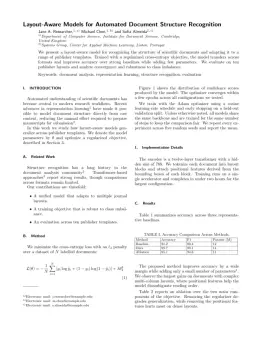
Nanotechnology and Precision Engineering template — frequently asked questions

How do I write a paper in the Nanotechnology and Precision Engineering format?
In DocuGuru you write your manuscript in a normal editor — no LaTeX setup required — and select the Nanotechnology and Precision Engineering template. When you export, DocuGuru compiles the paper into the official AIP Publishing format and hands you a submission-ready PDF along with the editable LaTeX source.
What reference style does Nanotechnology and Precision Engineering use?
Nanotechnology and Precision Engineering uses Numbered (AIP) references, shown as numbered [1], [2] markers in the text. DocuGuru formats every in-text citation and the reference list in this exact style automatically. A reference appears like this: [1] A. Smith, B. Jones, and C. Lee, Nanotechnology and Precision Engineering 12, 45 (2023).
Do I need to know LaTeX to submit to Nanotechnology and Precision Engineering?
No. DocuGuru generates the revtex4-2 LaTeX class and compiles the PDF for you in the background, so you get a AIP Publishing-ready Nanotechnology and Precision Engineering document without writing any LaTeX. If you do want it, the LaTeX source is included in the export.
Can I import an existing draft into the Nanotechnology and Precision Engineering template?
Yes. Paste or upload your current manuscript — Word, LaTeX, Markdown, or plain text — and DocuGuru reflows it into the Nanotechnology and Precision Engineering format with correct headings, figures, tables, and numbered citations.
Who publishes Nanotechnology and Precision Engineering?
Nanotechnology and Precision Engineering is a physics journal published by AIP Publishing. DocuGuru's Nanotechnology and Precision Engineering template matches AIP Publishing's official submission format.
Can I export a submission-ready Nanotechnology and Precision Engineering PDF?
Yes — DocuGuru produces a PDF built with the official Nanotechnology and Precision Engineering template (the revtex4-2 class) that is ready to submit to AIP Publishing, together with the matching LaTeX source files.
How much does the Nanotechnology and Precision Engineering template cost?
You can start writing in the Nanotechnology and Precision Engineering template for free. Exporting the final submission-ready Nanotechnology and Precision Engineering PDF and LaTeX source is part of DocuGuru's paid plans — see the app for current pricing.
Use the Nanotechnology and Precision Engineering template