American Chemical Society

Precision Chemistry Template

Write in a clean editor, then format for Precision Chemistry in one click — DocuGuru applies the official American Chemical Society template with superscript references and exports a submission-ready PDF plus the editable LaTeX source. Free to start.

About the Precision Chemistry format

Precision Chemistry is a peer-reviewed journal published by American Chemical Society, covering Electrocatalysts for Energy Conversion, Gender, Feminism, and Media, Gothic Literature and Media Analysis.

PublisherAmerican Chemical Society
Reference styleSuperscript numbered (ACS)
Superscript — small raised numerals in the text
(1) Smith, A.; Jones, B.; Lee, C. A Representative Article Title. Precision Chemistry 2023, 12, 45–58.

Formats any DOI in Precision Chemistry style. No sign-up.

Publishes research inElectrocatalysts for Energy Conversion Gender, Feminism, and Media Gothic Literature and Media Analysis Diverse Scientific and Economic Studies Human auditory perception and evaluation
ISSN2771-9316
Citation impact (2-yr)5.2
h-index27
i10-index104
Total citations3,140
Open accessYes
Top institutions publishing hereUniversity of Science and Technology of China
You getA submission-ready PDF and the editable LaTeX source — ready to submit.

Papers published in Precision Chemistry per year

1
2000
1
2016
92
2023
95
2024
125
2025

Citation impact of Precision Chemistry by publication year

14
2000
0
2016
1.4K
2023
1.2K
2024
399
2025

Citations each year’s papers have accumulated so far — the most recent years are still building up.

Most-cited papers in Precision Chemistry

Spin-Modulated Oxygen Electrocatalysis

Zhi Fang, Wanting Zhao, Tong Shen et al. · 1 Aug 2023

High Resolution Image Download MS PowerPoint Slide The electrocatalysis reactions involving oxygen, such as oxygen evolution reaction (OER) and oxygen reduction reaction (ORR), play a critical role in energy storage/conversion applications, e.g., fuel cells, metal-air batteries, and electrochemical water splitting. The high kinetic energy barrier of the OER/ORR is highly associated with the spin state…

Liquid Phase Exfoliation of 2D Materials and Its Electrochemical Applications in the Data-Driven Future

Panwad Chavalekvirat, Wisit Hirunpinyopas, Krittapong Deshsorn et al. · 29 Mar 2024

The electrochemical properties of 2D materials, particularly transition metal dichalcogenides (TMDs), hinge on their structural and chemical characteristics. To be practically viable, achieving large-scale, high-yield production is crucial, ensuring both quality and electrochemical suitability for applications in energy storage, electrocatalysis, and potential-based ionic sieving membranes. A prerequisite for success is a deep understanding of the…

Challenges in Photocatalytic Carbon Dioxide Reduction

Guangfu Liao, Guixiang Ding, Bin Yang et al. · 17 Jan 2024

High Resolution Image Download MS PowerPoint Slide An energy crisis and significant anthropogenic CO 2 emissions as a result of rising fossil fuel consumption have caused a rapid increase in global temperature. One of the best solutions to these two issues is thought to be the photocatalytic reduction of CO 2 into value-added carbon-containing products.…

Size Effects of Atomically Precise Gold Nanoclusters in Catalysis

Site Li, Xiang‐Sha Du, Zhongyu Liu et al. · 15 Mar 2023

The emergence of ligand-protected, atomically precise gold nanoclusters (NCs) in recent years has attracted broad interest in catalysis due to their well-defined atomic structures and intriguing properties. Especially, the precise formulas of NCs provide an opportunity to study the size effects at the atomic level without complications by the polydispersity in conventional nanoparticles that obscures…

Investigation and Mitigation of Carbon Deposition over Copper Catalyst during Electrochemical CO<sub>2</sub> Reduction

Jing-Wen DuanMu, Zhi‐Zheng Wu, Fei‐Yue Gao et al. · 1 Mar 2024

High Resolution Image Download MS PowerPoint Slide Copper (Cu) is considered to be the most effective catalyst for electrochemical conversion of carbon dioxide (CO 2 ) into value-added hydrocarbons, but its stability still faces considerable challenge. Here, we report the poisoning effect of carbon deposition during CO 2 reduction on the active sites of Cu…

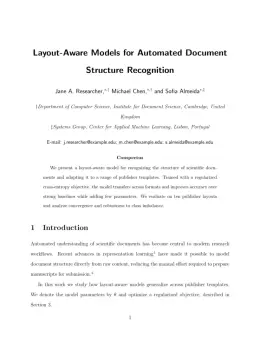
Precision Chemistry template — frequently asked questions

How do I write a paper in the Precision Chemistry format?
In DocuGuru you write your manuscript in a normal editor — no LaTeX setup required — and select the Precision Chemistry template. When you export, DocuGuru compiles the paper into the official American Chemical Society format and hands you a submission-ready PDF along with the editable LaTeX source.
What reference style does Precision Chemistry use?
Precision Chemistry uses Superscript numbered (ACS) references, shown as superscript numerals in the text. DocuGuru formats every in-text citation and the reference list in this exact style automatically. A reference appears like this: (1) Smith, A.; Jones, B.; Lee, C. A Representative Article Title. Precision Chemistry 2023, 12, 45–58.
Do I need to know LaTeX to submit to Precision Chemistry?
No. DocuGuru generates the achemso LaTeX class and compiles the PDF for you in the background, so you get a American Chemical Society-ready Precision Chemistry document without writing any LaTeX. If you do want it, the LaTeX source is included in the export.
Can I import an existing draft into the Precision Chemistry template?
Yes. Paste or upload your current manuscript — Word, LaTeX, Markdown, or plain text — and DocuGuru reflows it into the Precision Chemistry format with correct headings, figures, tables, and superscript citations.
Who publishes Precision Chemistry?
Precision Chemistry is a chemistry journal published by American Chemical Society. DocuGuru's Precision Chemistry template matches American Chemical Society's official submission format.
Can I export a submission-ready Precision Chemistry PDF?
Yes — DocuGuru produces a PDF built with the official Precision Chemistry template (the achemso class) that is ready to submit to American Chemical Society, together with the matching LaTeX source files.
How much does the Precision Chemistry template cost?
You can start writing in the Precision Chemistry template for free. Exporting the final submission-ready Precision Chemistry PDF and LaTeX source is part of DocuGuru's paid plans — see the app for current pricing.
Use the Precision Chemistry template