American Chemical Society

Chemical & Biomedical Imaging Template

Write in a clean editor, then format for Chemical & Biomedical Imaging in one click — DocuGuru applies the official American Chemical Society template with superscript references and exports a submission-ready PDF plus the editable LaTeX source. Free to start.

About the Chemical & Biomedical Imaging format

Chemical & Biomedical Imaging is a peer-reviewed journal published by American Chemical Society, covering Nanoplatforms for cancer theranostics, Advanced biosensing and bioanalysis techniques, Advanced Fluorescence Microscopy Techniques.

PublisherAmerican Chemical Society
Reference styleSuperscript numbered (ACS)
Superscript — small raised numerals in the text
(1) Smith, A.; Jones, B.; Lee, C. A Representative Article Title. Chemical & Biomedical Imaging 2023, 12, 45–58.

Formats any DOI in Chemical & Biomedical Imaging style. No sign-up.

Publishes research inNanoplatforms for cancer theranostics Advanced biosensing and bioanalysis techniques Advanced Fluorescence Microscopy Techniques Molecular Sensors and Ion Detection Spectroscopy Techniques in Biomedical and Chemical Research
ISSN2832-3637
Citation impact (2-yr)3.27
h-index27
i10-index106
Total citations3,137
Open accessYes
Top institutions publishing hereNanjing University
You getA submission-ready PDF and the editable LaTeX source — ready to submit.

Papers published in Chemical & Biomedical Imaging per year

1
1999
1
2010
1
2022
111
2023
99
2024
179
2025

Citation impact of Chemical & Biomedical Imaging by publication year

0
1999
0
2010
8
2022
1.8K
2023
741
2024
466
2025

Citations each year’s papers have accumulated so far — the most recent years are still building up.

Most-cited papers in Chemical & Biomedical Imaging

A Close Look at Mechanism, Application, and Opportunities of Electrochemiluminescence Microscopy

Xiaodan Gou, Zejing Xing, Cheng Ma et al. · 6 Mar 2023

Electrochemiluminescence (ECL) is a typical luminescence process triggered by electrochemical reactions. Due to the separated signal types, ECL measurements have some merits of high sensitivity, low background, and simple configuration. Coupled with a microscopy setup, ECL microscopy (ECLM) has the unique characteristics of ECL and is also furnished with spatiotemporal resolution. Thus, many applications have…

Molecular Design of NIR-II Polymethine Fluorophores for Bioimaging and Biosensing

Yifeng Ou, Tian‐Bing Ren, Lin Yuan et al. · 18 May 2023

Organic polymethine fluorophores with emission in the NIR-II window (1000-1700 nm) are receiving enormous attention in biomolecular medicine and bioimaging, attributed to the high absorption coefficients, bright NIR-II emission, excellent biocompatibility, and molecule adjustability. Recently, researchers have devoted significant effort to designing and improving NIR-II polymethine fluorophores and making notable progress in the NIR-II fluorescence…

Chemical Regulation of Fluorescence Lifetime

Jianan Dai, Xin Zhang · 26 Oct 2023

Fluorescence lifetime has significant applications in the field of fluorescence microscopy. Effective modulation of fluorescence lifetime can be achieved by controlling the radiative versus nonradiative processes of fluorophores. In this review, we systematically analyze and summarize chemical approaches that achieve fluorescence lifetime modulation for three different types of fluorophores, including small molecules, quantum dots, and…

Fluorogenic Reactions in Chemical Biology: Seeing Chemistry in Cells

Yanyan Chen, Hao Jiang, Tingting Hao et al. · 30 May 2023

Among the recent development of click chemistry and bioorthogonal chemistry, fluorogenic reactions occupy a unique place in that fluorescence is generated from nonfluorescent reactants, thereby rendering them highly useful and convenient in no-wash live-cell imaging. This topic was extensively reviewed in 2010 by Wang et al. (Chem. Soc. Rev.2010, 39, 1233-1239) and in 2014 by…

The Bioimaging Story of AIEgens

Siyuan Wang, Kun Zhou, Xinyan Lyu et al. · 3 Jul 2023

Observations of the micro world, especially the structures of organelles, have been attractive topics since the 17th century. As a powerful detection tool, the fluorescence technique has played a significant role in bioimaging to provide more details and enhance the signal-to-noise ratio compared to that of traditional optical microscopes. The boom of aggregate-induced emission luminogens…

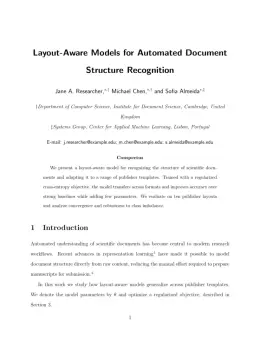
Chemical & Biomedical Imaging template — frequently asked questions

How do I write a paper in the Chemical & Biomedical Imaging format?
In DocuGuru you write your manuscript in a normal editor — no LaTeX setup required — and select the Chemical & Biomedical Imaging template. When you export, DocuGuru compiles the paper into the official American Chemical Society format and hands you a submission-ready PDF along with the editable LaTeX source.
What reference style does Chemical & Biomedical Imaging use?
Chemical & Biomedical Imaging uses Superscript numbered (ACS) references, shown as superscript numerals in the text. DocuGuru formats every in-text citation and the reference list in this exact style automatically. A reference appears like this: (1) Smith, A.; Jones, B.; Lee, C. A Representative Article Title. Chemical & Biomedical Imaging 2023, 12, 45–58.
Do I need to know LaTeX to submit to Chemical & Biomedical Imaging?
No. DocuGuru generates the achemso LaTeX class and compiles the PDF for you in the background, so you get a American Chemical Society-ready Chemical & Biomedical Imaging document without writing any LaTeX. If you do want it, the LaTeX source is included in the export.
Can I import an existing draft into the Chemical & Biomedical Imaging template?
Yes. Paste or upload your current manuscript — Word, LaTeX, Markdown, or plain text — and DocuGuru reflows it into the Chemical & Biomedical Imaging format with correct headings, figures, tables, and superscript citations.
Who publishes Chemical & Biomedical Imaging?
Chemical & Biomedical Imaging is a chemistry journal published by American Chemical Society. DocuGuru's Chemical & Biomedical Imaging template matches American Chemical Society's official submission format.
Can I export a submission-ready Chemical & Biomedical Imaging PDF?
Yes — DocuGuru produces a PDF built with the official Chemical & Biomedical Imaging template (the achemso class) that is ready to submit to American Chemical Society, together with the matching LaTeX source files.
How much does the Chemical & Biomedical Imaging template cost?
You can start writing in the Chemical & Biomedical Imaging template for free. Exporting the final submission-ready Chemical & Biomedical Imaging PDF and LaTeX source is part of DocuGuru's paid plans — see the app for current pricing.
Use the Chemical & Biomedical Imaging template