American Chemical Society

Accounts of Materials Research Template

Write in a clean editor, then format for Accounts of Materials Research in one click — DocuGuru applies the official American Chemical Society template with superscript references and exports a submission-ready PDF plus the editable LaTeX source. Free to start.

About the Accounts of Materials Research format

Accounts of Materials Research is a peer-reviewed journal published by American Chemical Society, covering Advancements in Battery Materials, Advanced Sensor and Energy Harvesting Materials, Covalent Organic Framework Applications. Over its lifetime it has published 825 papers, which have received 25,995 citations.

PublisherAmerican Chemical Society
Reference styleSuperscript numbered (ACS)
Superscript — small raised numerals in the text
(1) Smith, A.; Jones, B.; Lee, C. A Representative Article Title. Accounts of Materials Research 2023, 12, 45–58.

Formats any DOI in Accounts of Materials Research style. No sign-up.

Publishes research inAdvancements in Battery Materials Advanced Sensor and Energy Harvesting Materials Covalent Organic Framework Applications Advanced Photocatalysis Techniques Metal-Organic Frameworks: Synthesis and Applications
ISSN2643-6728
Citation impact (2-yr)11.88
h-index80
i10-index480
Top institutions publishing hereChinese Academy of Sciences
Journal websitepubs.acs.org
You getA submission-ready PDF and the editable LaTeX source — ready to submit.

Papers published in Accounts of Materials Research per year

35
2020
150
2021
135
2022
117
2023
169
2024
140
2025

Citation impact of Accounts of Materials Research by publication year

2.1K
2020
9K
2021
6.2K
2022
3.6K
2023
3.1K
2024
1.2K
2025

Citations each year’s papers have accumulated so far — the most recent years are still building up.

Most-cited papers in Accounts of Materials Research

Nanozymes Inspired by Natural Enzymes

Ruofei Zhang, Xiyun Yan, Kelong Fan · 24 Jun 2021

ConspectusNanozymes, nanomaterials with enzyme-like activities with high structural stability, adjustable catalytic activity, functional diversity, recyclability, and feasibility in large-scale preparation, have become a hot spot in the field of artificial enzymes in recent years and are expected to become potential surrogates and competitors for natural enzymes in practical applications. With the development of in-depth research…

Hydrogen-Bonded Organic Frameworks: A Rising Class of Porous Molecular Materials

Penghao Li, Matthew R. Ryder, J. Fraser Stoddart · 13 Oct 2020

ConspectusHydrogen-bonded organic frameworks (HOFs) are a class of porous molecular materials that rely on the assembly of organic building blocks by means of hydrogen-bonding interactions to form two-dimensional (2D) and three-dimensional (3D) crystalline networks. The reversible nature of the hydrogen-bond formation endows HOFs with the attributes of solution processability and simple regeneration. High-quality single crystals…

Microenvironment Modulation in Metal–Organic Framework-Based Catalysis

Long Jiao, Jingxue Wang, Hai‐Long Jiang · 26 Feb 2021

ConspectusThe fine design and regulation of catalysts play critical roles in the development of catalysis. The microenvironment, which gives rise to unique spatial structures and electronic properties around catalytic sites, has been proven to dramatically regulate catalytic behavior in enzymes and homogeneous catalysis. However, understanding the microenvironment modulation (MEM) of catalytic sites remains challenging and…

Interpretable and Explainable Machine Learning for Materials Science and Chemistry

Felipe Oviedo, Juan Lavista Ferres, Tonio Buonassisi et al. · 3 Jun 2022

While the uptake of data-driven approaches for materials science and chemistry is at an exciting, early stage, to realise the true potential of machine learning models for successful scientific discovery, they must have qualities beyond purely predictive power. The predictions and inner workings of models should provide a certain degree of explainability by human experts,…

Breaking the Scaling Relationship Limit: From Single-Atom to Dual-Atom Catalysts

Longbin Li, Kai Yuan, Yiwang Chen · 17 May 2022

ConspectusRecent decades have witnessed the rapid development of catalytic science, especially after Taylor and Armstrong proposed the notion of the “active site” in 1925. By optimizing reaction paths and reducing the activation energies of reactions, catalysts appear in more than 90% of chemical production reactions, involving homogeneous catalysis, heterogeneous catalysis, and enzyme catalysis. Because of…

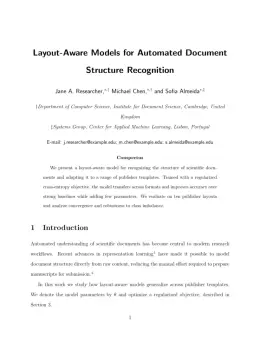
Accounts of Materials Research template — frequently asked questions

How do I write a paper in the Accounts of Materials Research format?
In DocuGuru you write your manuscript in a normal editor — no LaTeX setup required — and select the Accounts of Materials Research template. When you export, DocuGuru compiles the paper into the official American Chemical Society format and hands you a submission-ready PDF along with the editable LaTeX source.
What reference style does Accounts of Materials Research use?
Accounts of Materials Research uses Superscript numbered (ACS) references, shown as superscript numerals in the text. DocuGuru formats every in-text citation and the reference list in this exact style automatically. A reference appears like this: (1) Smith, A.; Jones, B.; Lee, C. A Representative Article Title. Accounts of Materials Research 2023, 12, 45–58.
Do I need to know LaTeX to submit to Accounts of Materials Research?
No. DocuGuru generates the achemso LaTeX class and compiles the PDF for you in the background, so you get a American Chemical Society-ready Accounts of Materials Research document without writing any LaTeX. If you do want it, the LaTeX source is included in the export.
Can I import an existing draft into the Accounts of Materials Research template?
Yes. Paste or upload your current manuscript — Word, LaTeX, Markdown, or plain text — and DocuGuru reflows it into the Accounts of Materials Research format with correct headings, figures, tables, and superscript citations.
What is Accounts of Materials Research?
ACS journal (achemso). It is a chemistry journal, published by American Chemical Society.
Can I export a submission-ready Accounts of Materials Research PDF?
Yes — DocuGuru produces a PDF built with the official Accounts of Materials Research template (the achemso class) that is ready to submit to American Chemical Society, together with the matching LaTeX source files.
How much does the Accounts of Materials Research template cost?
You can start writing in the Accounts of Materials Research template for free. Exporting the final submission-ready Accounts of Materials Research PDF and LaTeX source is part of DocuGuru's paid plans — see the app for current pricing.
Use the Accounts of Materials Research template