
328 citations
Cite
SaveGo to paper →
ACM
ACM SIGDA Newsletter Template
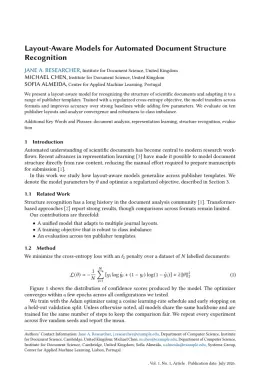
Write in a clean editor, then format for ACM SIGDA Newsletter in one click — DocuGuru applies the official ACM template with numbered references and exports a submission-ready PDF plus the editable LaTeX source. Free to start.
About the ACM SIGDA Newsletter format
ACM SIGDA Newsletter is a peer-reviewed journal published by ACM, covering Embedded Systems Design Techniques, VLSI and FPGA Design Techniques, Manufacturing Process and Optimization.
| Publisher | ACM |
|---|---|
| Reference style | Numbered (ACM) Numbered — [1], [2] in the text [1] Ada Smith, Ben Jones, and Cara Lee. 2023. A representative article title. ACM SIGDA Newsletter 12, 3, Article 45 (2023).
Formats any DOI in ACM SIGDA Newsletter style. No sign-up. |
| Publishes research in | Embedded Systems Design Techniques VLSI and FPGA Design Techniques Manufacturing Process and Optimization VLSI and Analog Circuit Testing Parallel Computing and Optimization Techniques |
| ISSN | 0163-5743 |
| h-index | 10 |
| i10-index | 10 |
| Total citations | 971 |
| Top institutions publishing here | IBM (United States) |
| Journal website | books.google.com |
| You get | A submission-ready PDF and the editable LaTeX source — ready to submit. |
Papers published in ACM SIGDA Newsletter per year
Citation impact of ACM SIGDA Newsletter by publication year
Citations each year’s papers have accumulated so far — the most recent years are still building up.
Most-cited papers in ACM SIGDA Newsletter
A simple method of converting statements in mathematical logic to equivalent interconnection problems is demonstrated. This shows that if there exists a practical method for solving interconnection problems, then there exists a practical proof procedure for statements in mathematical logic. (In the terminology of Cook [1] and Karp [4], the interconnection problem is NP-complete.) Since…
152 citations
Cite
SaveGo to paper →
132 citations
Cite
SaveGo to paper →
Formal verification is the use of mathematical techniques to ensure that a design conforms to some precisely expressed notion of functional correctness. Concretely, assume that you have (1) a model of a design, (2) some description of the environment that the design is supposed to operate in, and (3) some properties that the design is…
41 citations
Cite
SaveGo to paper →
The minimum feature size of CMOS technology will reach 10nm in ten years. Beyond that benchmark, the present scaling approach may have to take a different route. The grand challenge to integrated circuit design community is to identify alternative technologies, such as carbon-based electronics, integrate them into the circuit architecture, and enable continuous growth of…
33 citations
Cite
SaveGo to paper →
Related journal templates
 ACM Transactions on Internet of Things
ACM Transactions on Internet Technology
ACM Transactions on Knowledge Discovery from Data
ACM Transactions on Management Information Systems
ACM Transactions on Mathematical Software
ACM Transactions on Modeling and Computer Simulation
ACM Transactions on Modeling and Performance Evaluation of Computing Systems
ACM Transactions on Multimedia Computing, Communications, and Applications
ACM SIGDA Newsletter template — frequently asked questions
How do I write a paper in the ACM SIGDA Newsletter format?
In DocuGuru you write your manuscript in a normal editor — no LaTeX setup required — and select the ACM SIGDA Newsletter template. When you export, DocuGuru compiles the paper into the official ACM format and hands you a submission-ready PDF along with the editable LaTeX source.
What reference style does ACM SIGDA Newsletter use?
ACM SIGDA Newsletter uses Numbered (ACM) references, shown as numbered [1], [2] markers in the text. DocuGuru formats every in-text citation and the reference list in this exact style automatically. A reference appears like this: [1] Ada Smith, Ben Jones, and Cara Lee. 2023. A representative article title. ACM SIGDA Newsletter 12, 3, Article 45 (2023).
Do I need to know LaTeX to submit to ACM SIGDA Newsletter?
No. DocuGuru generates the acmart LaTeX class and compiles the PDF for you in the background, so you get a ACM-ready ACM SIGDA Newsletter document without writing any LaTeX. If you do want it, the LaTeX source is included in the export.
Can I import an existing draft into the ACM SIGDA Newsletter template?
Yes. Paste or upload your current manuscript — Word, LaTeX, Markdown, or plain text — and DocuGuru reflows it into the ACM SIGDA Newsletter format with correct headings, figures, tables, and numbered citations.
Who publishes ACM SIGDA Newsletter?
ACM SIGDA Newsletter is a engineering and computer science journal published by ACM. DocuGuru's ACM SIGDA Newsletter template matches ACM's official submission format.
Can I export a submission-ready ACM SIGDA Newsletter PDF?
Yes — DocuGuru produces a PDF built with the official ACM SIGDA Newsletter template (the acmart class) that is ready to submit to ACM, together with the matching LaTeX source files.
How much does the ACM SIGDA Newsletter template cost?
You can start writing in the ACM SIGDA Newsletter template for free. Exporting the final submission-ready ACM SIGDA Newsletter PDF and LaTeX source is part of DocuGuru's paid plans — see the app for current pricing.