
1,732 citations
Cite
SaveGo to paper →
ACM
ACM SIGBIO Newsletter Template
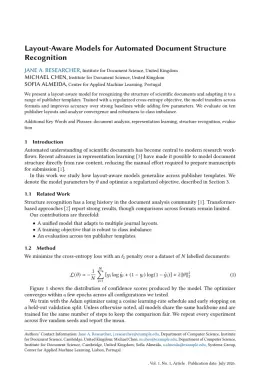
Write in a clean editor, then format for ACM SIGBIO Newsletter in one click — DocuGuru applies the official ACM template with numbered references and exports a submission-ready PDF plus the editable LaTeX source. Free to start.
About the ACM SIGBIO Newsletter format
ACM SIGBIO Newsletter is a peer-reviewed journal published by ACM, covering Electronic Health Records Systems, Scientific Computing and Data Management, Genetics, Bioinformatics, and Biomedical Research.
| Publisher | ACM |
|---|---|
| Reference style | Numbered (ACM) Numbered — [1], [2] in the text [1] Ada Smith, Ben Jones, and Cara Lee. 2023. A representative article title. ACM SIGBIO Newsletter 12, 3, Article 45 (2023).
Formats any DOI in ACM SIGBIO Newsletter style. No sign-up. |
| Publishes research in | Electronic Health Records Systems Scientific Computing and Data Management Genetics, Bioinformatics, and Biomedical Research Data Mining Algorithms and Applications Health Sciences Research and Education |
| ISSN | 0163-5697 |
| h-index | 12 |
| i10-index | 17 |
| Total citations | 2,601 |
| Top institutions publishing here | Wayne State University |
| You get | A submission-ready PDF and the editable LaTeX source — ready to submit. |
Papers published in ACM SIGBIO Newsletter per year
Citation impact of ACM SIGBIO Newsletter by publication year
Citations each year’s papers have accumulated so far — the most recent years are still building up.
Most-cited papers in ACM SIGBIO Newsletter
article Free Access Share on Visualization in scientific computing Author: B. H. McCormick View Profile Authors Info & Claims ACM SIGBIO NewsletterVolume 10Issue 1March, 1988 pp 15–21https://doi.org/10.1145/43965.43966Published:01 March 1988Publication History 96citation3,261DownloadsMetricsTotal Citations96Total Downloads3,261Last 12 Months315Last 6 weeks57 Get Citation AlertsNew Citation Alert added!This alert has been successfully added and will be sent to:You will be…
213 citations
Cite
SaveGo to paper →
The Biopython project was formed in August 1999 as a collaboration to collect and produce open source bioinformatics tools written in Python, an object-oriented scripting language. It is modeled on the highly successful Bioperl project, but has the goal of making libraries available for people doing computations in Python. The philosophy of all the Bio*…
207 citations
Cite
SaveGo to paper →
The considerable "algorithmic complexity" of biological systems requires a huge amount of detailed information for their complete description. Current high-throughput technology such as microarrays is generating an overwhelming amount of data of biological systems at the molecular and cellular level. To adequately organize, maintain, analyze and interpret this deluge of information the adaptation of existing…
44 citations
Cite
SaveGo to paper →
BioJava is an open source Java library for bioinformatics. It is highly object oriented, allowing extensive customization without extensive code writing. The project is coordinated from the web site at http://www.biojava.org and the mailing list for related discussion is biojava-1@biojava.org.
44 citations
Cite
SaveGo to paper →
Related journal templates
 ACM Transactions on Algorithms
ACM Transactions on Autonomous and Adaptive Systems
ACM Transactions on Computer-Human Interaction
ACM Transactions on Database Systems
ACM Transactions on Evolutionary Learning and Optimization
ACM Transactions on Intelligent Systems and Technology
ACM Transactions on Knowledge Discovery from Data
ACM Transactions on Modeling and Performance Evaluation of Computing Systems
ACM SIGBIO Newsletter template — frequently asked questions
How do I write a paper in the ACM SIGBIO Newsletter format?
In DocuGuru you write your manuscript in a normal editor — no LaTeX setup required — and select the ACM SIGBIO Newsletter template. When you export, DocuGuru compiles the paper into the official ACM format and hands you a submission-ready PDF along with the editable LaTeX source.
What reference style does ACM SIGBIO Newsletter use?
ACM SIGBIO Newsletter uses Numbered (ACM) references, shown as numbered [1], [2] markers in the text. DocuGuru formats every in-text citation and the reference list in this exact style automatically. A reference appears like this: [1] Ada Smith, Ben Jones, and Cara Lee. 2023. A representative article title. ACM SIGBIO Newsletter 12, 3, Article 45 (2023).
Do I need to know LaTeX to submit to ACM SIGBIO Newsletter?
No. DocuGuru generates the acmart LaTeX class and compiles the PDF for you in the background, so you get a ACM-ready ACM SIGBIO Newsletter document without writing any LaTeX. If you do want it, the LaTeX source is included in the export.
Can I import an existing draft into the ACM SIGBIO Newsletter template?
Yes. Paste or upload your current manuscript — Word, LaTeX, Markdown, or plain text — and DocuGuru reflows it into the ACM SIGBIO Newsletter format with correct headings, figures, tables, and numbered citations.
Who publishes ACM SIGBIO Newsletter?
ACM SIGBIO Newsletter is a engineering and computer science journal published by ACM. DocuGuru's ACM SIGBIO Newsletter template matches ACM's official submission format.
Can I export a submission-ready ACM SIGBIO Newsletter PDF?
Yes — DocuGuru produces a PDF built with the official ACM SIGBIO Newsletter template (the acmart class) that is ready to submit to ACM, together with the matching LaTeX source files.
How much does the ACM SIGBIO Newsletter template cost?
You can start writing in the ACM SIGBIO Newsletter template for free. Exporting the final submission-ready ACM SIGBIO Newsletter PDF and LaTeX source is part of DocuGuru's paid plans — see the app for current pricing.